AI
OpenAI Astra: Can AI Discover Answers That Don't Exist Yet?
ChatGPT usually works with knowledge humans already created. OpenAI says Astra generated new mathematical arguments for open problems, raising a bigger question: can AI help discover answers humans have not found yet?

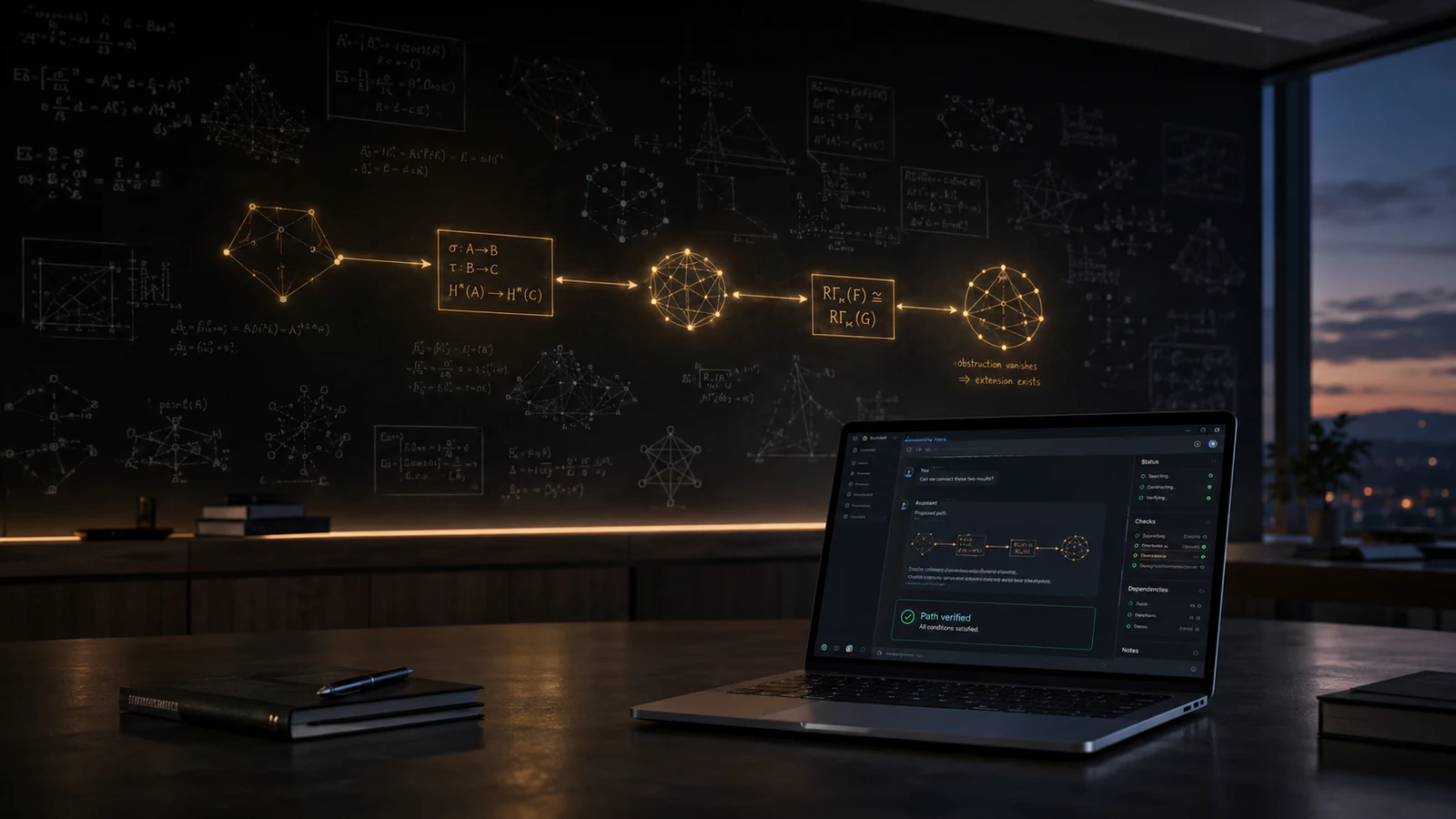
Almost everything impressive about ChatGPT comes with an invisible footnote: somewhere, a human figured it out first.
Ask it to explain a medical term, compare two business models, or fix a piece of code. The answer may arrive in seconds, but the knowledge behind it usually came from books, websites, research papers, and examples created by people.
AI became remarkably good at finding that knowledge, connecting it, and explaining it back to us.
But what happens when the answer is not in a book, on Google, or anywhere else?
On August 1, 2026, OpenAI published a 249-page paper containing ten new results in mathematics and theoretical computer science. OpenAI says the mathematical arguments were generated by an internal version of Astra, which it calls its "next major model."
Some results resolved long-standing open problems. Others pushed beyond the strongest answers researchers had reached before.
If OpenAI's claims stand up to wider examination, Astra was not simply faster at finding something humans already knew. It helped produce knowledge that did not previously exist in an accepted form.
We may be looking at an early step into a new AI era, one where AI does more than answer our questions and begins helping us discover answers humanity does not have yet.
What is OpenAI Astra?
OpenAI Astra is an unreleased version of what OpenAI describes as its next major AI model. OpenAI has not confirmed that Astra is GPT-6, announced when people can use it, or explained how it may appear inside ChatGPT.
The company introduced Astra through ten new mathematical results. According to OpenAI's announcement, each either resolved an open problem or made substantial progress. OpenAI says Astra generated the arguments, humans helped prepare the manuscripts, and the model formalized each argument in a format software can check.
That is what we know.
Whether that ability will transfer to science, business, or everyday life remains unknown.
The difference between finding an answer and discovering one

Think of Google as the world's biggest library. ChatGPT is like an incredibly fast librarian who has read an enormous part of it. It can pull ideas from different shelves, translate the difficult parts, and assemble a useful answer.
But the Astra claim is closer to the librarian returning with a new page that was never in the library, then showing enough of the reasoning for experts and software to check how it was created.
AI already creates useful combinations, writes new code, and finds patterns a person may miss. The difference here is the standard of the problem and the evidence behind the result.
These were open research questions. The mathematical community did not already have an accepted answer to retrieve.
OpenAI is saying its model generated the central arguments anyway.
That is more meaningful than another model gaining a few points on a benchmark.
What did Astra actually do?
The results cover fields such as high-dimensional geometry, coding theory, group theory, quantum complexity, and lattice cryptography. You do not need to understand those fields to understand the achievement.
An open problem is a question experts know how to ask but have not managed to answer. Researchers may work on one for years, slowly moving the boundary of what is known.
OpenAI says Astra moved that boundary ten times.
One result constructed a "non-sofic group," addressing a central question in group theory. Another disproved Connes's rigidity conjecture. A result in high-dimensional sphere packing improved a general bound for the first time since 1978. Two other results resolved three numbered problems associated with mathematician Paul Erdős.
The full OpenAI paper contains all ten results and runs for 249 pages.
You may see claims that Astra "solved ten impossible math problems." OpenAI's description is more careful: each result either resolved an open problem or made substantial progress.
Imagine ten teams trying to cross different stretches of unmapped land. Astra appears to have reached the destination in some cases. In others, it found a route far beyond the point where previous teams had stopped.
Both matter, but they are not the same claim.
How can anyone trust a proof written by AI?
AI can sound certain while being completely wrong. If ChatGPT invents a fact about online marketing, I may catch it because I know the subject. If it makes a false step inside advanced mathematics, almost everyone will miss it.
OpenAI used a system called Lean to make the work easier to verify.
Lean is a proof assistant. In simple terms, it checks mathematical logic step by step. A formal proof must express the reasoning precisely enough for software to test whether each step follows.
It is a little like asking someone to design a bridge, then checking every measurement and connection rather than approving it because the drawing looks professional.
OpenAI says Astra formalized each argument into a Lean certificate. It released the manuscripts and reasoning walkthroughs and says it takes responsibility for the work's correctness. OpenAI is direct about authorship too: the arguments came from the AI, while humans helped prepare the papers and formalize the proofs.
That makes the announcement much stronger than a collection of impressive chatbot screenshots.
Researchers still need to examine what was proved, understand its significance, compare it with existing work, and explore what follows. The wider mathematical community has only just received the results.
Why mathematics was the perfect place to cross this line
Mathematics gives AI something real life rarely does: rules that stay still. A proof does not become correct because it sounds intelligent. The logic can be examined and formally checked.
Most of the problems we actually want help with are messier.
There is no mathematical proof that a business idea will succeed. There is no objectively perfect YouTube title. The cheapest supplier may create the most customer complaints.
Even a difficult puzzle can be easier for AI than a simple human choice.
A complicated Sudoku has fixed rules and a correct solution. Choosing a birthday gift for your daughter depends on what she likes, what she owns, and what would make her feel understood.
An AI can be brilliant at the Sudoku and still choose a terrible gift.
Astra has shown this ability in an area built for precise reasoning and verification. That is a sensible place to start, but it is not the finish line.
What could this eventually look like outside a math department?

Imagine asking an AI today, "What online business should I start?"
You will probably get a familiar list: dropshipping, print on demand, affiliate marketing, a digital product, perhaps an AI agency. Thousands of other people can receive almost the same answer.
Now imagine a system that approaches the question differently.
It studies customer reviews, search patterns, forum discussions, competing products, supplier catalogs, and complaints. It notices that one group keeps describing the same unsolved frustration. The AI connects that need with a product that can be sourced, a way to reach those customers, and a small test of whether they will pay.
That would be an opportunity discovered across information no single person had time to connect.
Or take a business that already exists.
Today, AI can read a folder of invoices and calculate the total expenses. Useful, but straightforward.
A more capable system could compare orders, returns, supplier prices, advertising costs, chargebacks, and support messages. It might discover that the best-selling product loses money after replacements and refunds, then suggest a way to test a fix.
I have seen how difficult this becomes when the information inside a business is disconnected. Expenses sit in one place, customer messages in another, and sales data somewhere else. In the past, connecting everything was not always practical.
Now I create my own AI agents to help organize customer emails, connect expenses, and summarize monthly profits. That is already useful, but I still have to know what I am looking for.
What I would really want from a system like Astra is something that could study a full year of sales and find opportunities I had not considered. It might notice that certain products begin selling earlier in the season than expected, recommend similar products for the following year, and tell me when buyers usually start looking for them.
It could also examine pricing and profitability, identify products whose prices should change, suggest new products worth testing, and compare the advertising messages that work for me with those used by competitors.
That would go beyond organizing information I already understand. It would help uncover opportunities hidden across the business.
This is the future I find more interesting than an AI that simply writes faster.
We have spent the first part of the AI boom producing more content, code, images, and answers. The bigger change will come when AI helps us notice problems, opportunities, and solutions we would not have found alone.
Astra has not demonstrated those business abilities. They are my view of where this reasoning could lead if it transfers beyond mathematics.
What does OpenAI's $2,000 estimate mean?
OpenAI says the number of tokens used to find the ten results would cost roughly $2,000 at current Sol API rates.
Tokens are the small units of information an AI reads and produces. Through an API, they are part of the usage bill.
The estimate covers model usage behind the successful results. It does not include training Astra, infrastructure, researchers, problem selection, paper preparation, or system development.
That makes it a supporting detail, not the breakthrough itself.
Still, it hints that using an already-built model to attack a hard problem may become relatively affordable. Serious problem-solving power could eventually reach smaller companies, universities, and independent teams.
What Astra does not prove
Is OpenAI Astra GPT-6?
OpenAI has not confirmed that Astra is GPT-6.
The company calls it an internal version of its "next major model." Until OpenAI announces a product, calling Astra GPT-6 is speculation.
Does Astra mean AGI has arrived?
No. Astra's results are not proof of AGI.
AGI stands for artificial general intelligence. People generally use it to describe AI that can perform most intellectual tasks at or above a capable human level.
Producing major mathematical arguments does not prove Astra can understand customers, manage a team, plan a family holiday, or make good decisions with incomplete information.
Astra may be exceptional at mathematical research and fail elsewhere. We do not have enough public evidence to know.
What changes for the rest of us today?
You cannot use Astra yet, so there is no tool to install or new feature to learn.
But this announcement gives us a useful way to think about the AI we already have.
Most people ask AI for immediate answers. Better results often come when you give it the real problem, useful context, and permission to challenge the obvious conclusion.
Instead of asking for ten business ideas, provide your budget, skills, time, location, risk tolerance, and the work you refuse to do. Ask the AI to compare options, expose missing evidence, argue against its preferred answer, and design an inexpensive test.
Instead of asking how to improve a website, include the offer, traffic sources, analytics, recordings, and customer messages. Ask it to rank likely causes and propose a test that separates one explanation from another.
Current AI still confuses plausible stories with supported conclusions. Check its evidence and use your judgment.
But there is a meaningful difference between asking AI to generate an answer and giving it enough context to help you discover one.
Is Astra the beginning of a new AI era?

I do not think the biggest story here is that an AI became better at mathematics.
It is the possibility that we are watching AI move beyond the library.
For years, ChatGPT made existing human knowledge easier to access. Astra suggests that future systems may also help expand it by staying with problems whose answers cannot simply be found.
Mathematics is the cleanest place to prove that ability because a new answer can be checked with unusual precision. The real test comes next.
Can the same system help a scientist find an overlooked treatment path? Can it help an engineer discover a safer design? Can it spot a business opportunity hidden in years of customer frustration?
We are not there yet.
What excites me most is not simply getting longer or more intelligent-sounding answers.
It is the possibility of AI hallucinating less, making fewer assumptions, and doing more than repackaging whatever it can find through search. If systems can produce better-supported answers and workflows without filling the gaps with guesses, that could be a real breakthrough in both the quality of the answers we receive and what we can confidently do with them.
But OpenAI published ten serious results, formal proof certificates, and a clear statement that the central arguments came from its model.
That feels less like a better search engine and more like the opening scene of something new.
Frequently asked questions
What is OpenAI Astra?
OpenAI Astra is an internal version of what OpenAI calls its next major AI model. OpenAI says it generated arguments across ten long-standing mathematical problems. Astra is not publicly available.
Did Astra solve ten unsolved math problems?
OpenAI says each result either resolved an open problem or made substantial progress. Not all ten were complete solutions.
How were Astra's results checked?
OpenAI says each argument was formalized into a Lean certificate. Lean checks mathematical logic step by step. The papers and reasoning walkthroughs are public.
Is OpenAI Astra GPT-6?
OpenAI has not confirmed that Astra is GPT-6. The final product name and release plan remain unknown.
Can I use OpenAI Astra now?
No. OpenAI has not announced public access, pricing, a release date, or how Astra may appear inside ChatGPT or the API.
Does Astra prove that AI can create new knowledge?
OpenAI presents Astra's arguments as new contributions to open problems and released formal certificates supporting them. Broader expert examination still matters, and this does not prove Astra can discover reliable answers in messier real-world situations.
Does Astra mean AGI is here?
No. AGI usually refers to AI with broad human-level ability across most intellectual tasks. Astra's mathematical results are significant, but they do not demonstrate that level of general capability.
Sources
About Liran Zablo
Liran Zablo has spent nearly a decade building ecommerce businesses, websites, content systems, and online marketing campaigns. As Head of Content at AutoDS, he built the company's content and education engine across YouTube, SEO, and long-form courses. On liranzablo.com, he explains important changes in AI through practical examples and tests how these tools can help normal people build and grow online businesses.